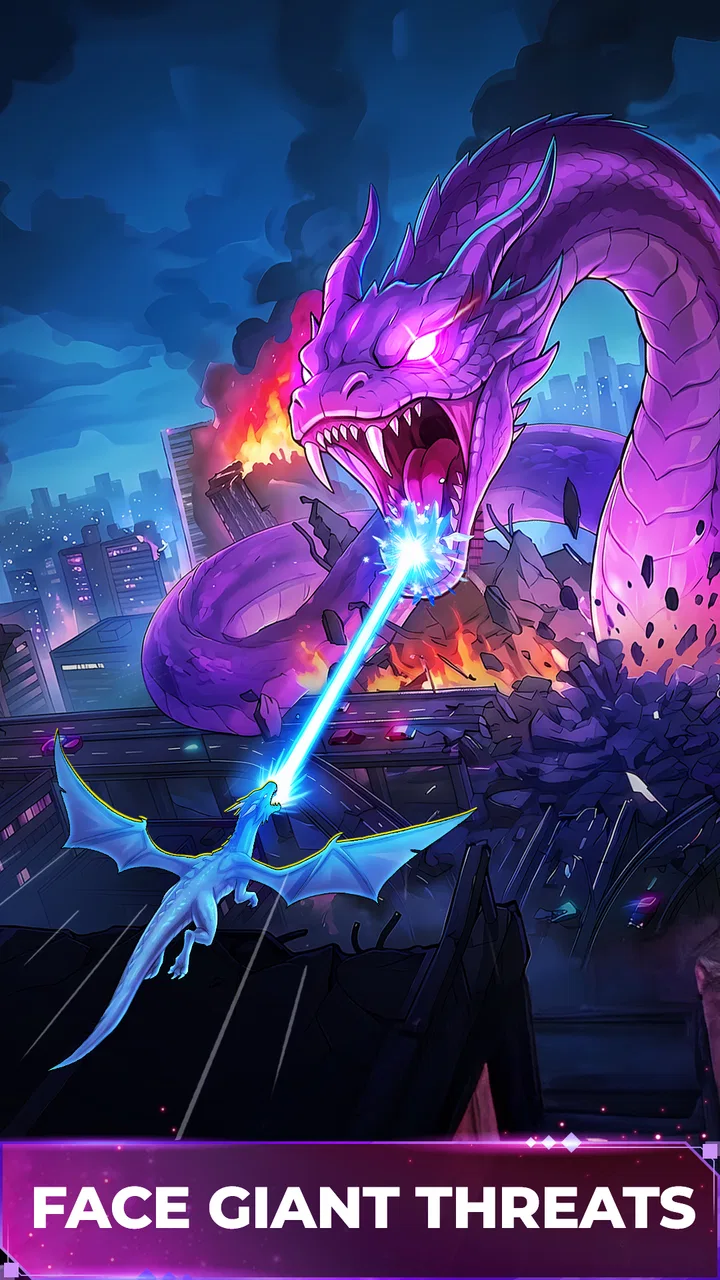
Dragon Wings - Space Shooter
- 4.8
- Rating
- 1.00M
- Installs
- Free
- Price

 Analysis by App-foxy
I went into Dragon Wings - Space Shooter expecting a quick mobile action game and found something more focused than its title first suggests. It puts you in control of a dragon in a modern-world battle against monsters, using the familiar rhythm of a scrolling shooter while giving the setting a much more unusual identity. The result is easy to understand within seconds: move, attack, survive, and keep improving your handling as the screen becomes more demanding.
That straightforward design is the game’s strongest starting point. I did not need a long tutorial or a complicated explanation before understanding what I was supposed to do. At the same time, the dragon theme gives the action enough personality to separate it from the many anonymous space shooters on mobile. It is still an action game built around quick reactions, but the fantasy-meets-modern setting makes each run feel less interchangeable.
Spirit Bomb - Heartcore Games is the developer behind the game, which is available free of charge and aimed at players aged ten and above. Its current version is 3.10.2, and it runs on Android 7.0 or later. The game has already passed one million installs and holds a 4.8 average from around 90 thousand ratings, so it clearly has a substantial audience. Those figures do not replace personal experience, but they do match my impression that this is a polished, accessible shooter rather than a rough experiment.
You May Also Like

 Blood Strike: 2.5 Anniversary
Blood Strike’s Loadouts Turn Every Drop Into a Tactical Gamble
A close look at Blood Strike’s custom loadouts: how fast access to signature weapons reshapes its battle royale rhythm, rewards preparation, and narrows the gap between fights.

 Pandora - Music & Podcasts
Pandora’s Music Is Easy to Start, but Harder to Recover
Pandora’s strength is its low-effort path from a seed to a station. Its weak spot is how much confidence it asks you to place in connection, setup, and quiet recovery.

 8 Ball Pool
 Is Built on Rivalries, Rematches, and Routine
A close look at the rivalries, rematches, shared routines, and unanswered safety questions that turn a quick pool match into a persistent mobile community.

 Samsung Music
’s Quiet Strength Is Playing What You Already Own
Its reach comes less from spectacle than from dependable access to a personal library. That simplicity is both the app’s strongest retention engine and its ceiling.

 AccuWeather: Weather Radar
AccuWeather Review: A Quick, Clear Forecast for Everyday Decisions
For everyday plans, the best forecast is the one you can understand quickly. AccuWeather makes rain timing, radar, and local conditions easy to act on, with a few trade-offs.

 Hill Climb Racing
Why Hill Climb Racing Still Turns Crashes Into One More Run
A tiny car, a bumpy hill and one more upgrade: Hill Climb Racing keeps resurfacing because its simple chaos makes every near-miss feel personal.
More From Our News Desk



How the first sessions establish a reason to keep playing
The early goals are deliberately readable. I always knew whether I was trying to survive the immediate wave, defeat the enemies in front of me, or reach the next meaningful point in a run. That clarity matters in a mobile game, especially when I only have a few minutes available. There is no need to study a large map or remember a complicated quest chain before the action begins.
The first sessions work best when treated as practice rather than as a test of mastery. I initially focused too much on attacking and not enough on positioning. That is a common mistake in this kind of game: the visual spectacle draws attention toward targets, while the real danger often comes from what is moving toward the dragon. Once I started watching open space and planning my movement before the screen became crowded, my runs felt more controlled.
That shift gives the early game a useful secondary goal. You are not only trying to clear enemies; you are learning how to read the battlefield. I found that the most productive improvement was not frantic tapping but better anticipation. Staying near a safe route, leaving room to change direction, and avoiding unnecessary movement made a larger difference than simply trying to attack faster.
The game also benefits from its compact premise. A traditional space shooter can sometimes bury its appeal under a large collection of ships, weapons, menus, and upgrades. Here, the dragon provides an immediate anchor. I understood what I was controlling and why the action felt different from a standard aircraft or spaceship. That makes the first few sessions friendly to newcomers without making the central challenge feel childish.
For an everyday scenario, I can easily see myself opening it during a short break, playing a run while waiting for an appointment, and closing it without needing to remember a complicated narrative thread. The action begins quickly, and the basic objective remains visible throughout. Players who prefer games that demand a long uninterrupted session may find that simplicity limiting, but for short bursts it is a real advantage.
What counts as progress when the action is the main attraction
The game’s progress signals are found less in elaborate storytelling and more in how each attempt teaches you something. A failed run can still feel useful if it reveals that I was taking the wrong line through a dangerous section or reacting too late to a threat. That kind of feedback is important because it gives a reason to restart beyond simply hoping for better luck.
I paid particular attention to the difference between visible progress and personal progress. Visible progress is reaching farther or handling more intense encounters. Personal progress is learning when to move, when to hold position, and when an apparently safe route is about to disappear. The second type is what kept me interested after the novelty of riding a dragon had worn off.
That does not mean every session produces a dramatic breakthrough. Some attempts feel routine, especially when I repeat an early section I already understand. This is where the pacing can become less exciting for players who want constant rewards or a highly elaborate upgrade structure. The game’s appeal depends heavily on whether you enjoy refining your play rather than collecting a new prize after every short session.
One useful habit is to give each run a small personal objective. Instead of treating success only as reaching the farthest possible point, I might focus on surviving a crowded section without panicking, keeping a safer position, or attacking while preserving an escape route. This turns repetition into deliberate practice and makes the action feel more purposeful.
I also think the game is better suited to players who enjoy recognizing patterns than to players who want completely unpredictable sessions. Repetition can be satisfying when it helps you understand timing and spacing. It becomes a weakness when you are looking for a constantly changing adventure. That distinction is worth considering before downloading, because the dragon theme may attract players who are actually seeking a broad fantasy campaign rather than an action-focused shooter.
Challenge, rhythm, and the point where casual play becomes demanding
The difficulty curve works because the game asks for attention gradually rather than relying only on speed. Early encounters give me room to settle into movement and targeting. Later pressure comes from having less freedom to make careless decisions, particularly when several threats compete for the same space. The important change is not simply that enemies become tougher; it is that mistakes become harder to recover from.
I found the best rhythm by alternating between aggression and caution. Attacking continuously feels satisfying, but it can also encourage tunnel vision. A safer approach is to clear the most immediate danger, reposition while the route is open, and then return attention to damage. This is one of the game’s more interesting trade-offs: playing too defensively can make a run feel slow, while playing too aggressively can remove the room needed to survive.
That balance gives the action more depth than a basic “hold attack and move” experience. The game remains approachable, but it rewards awareness. I would not describe it as a relaxed background game once the pressure increases. It demands enough concentration that I would avoid starting a serious run while distracted or trying to multitask.
The difficulty may also expose a limitation for players who dislike repeating sections. When a run ends because of one poor movement decision, restarting can be motivating if I understand the mistake. It can be frustrating if I feel that the failure came from visual overload or an unclear threat. My experience was generally more encouraging than punishing, but the game is still built around learning through attempts, so patience matters.
Players who want a gentle, almost idle experience should probably skip it. The action is more satisfying when I am actively watching the screen and making decisions. On the other hand, fans of arcade-style shooters who enjoy improving through repetition will find a clearer reason to return. It occupies a middle ground: easier to approach than a highly technical bullet-avoidance game, but more demanding than a shooter designed to be played without much attention.
Why the pacing can sustain interest, and where it may create pressure
The retention pressure comes from the natural desire to improve a run. I often finished an attempt already thinking about the moment where I lost control and how I could handle it differently next time. That is a healthy loop when the game makes the cause of failure understandable. It becomes less healthy when a player feels pushed to spend money simply to keep pace, so I paid attention to how the free entry point affected the experience.
The game is free to download and includes in-app purchases ranging from $0.99 to $149.99 per item. That is a wide range, and it is the main point where I would advise new players to be deliberate. I would begin by playing without buying anything, learning the movement and deciding whether the core loop genuinely holds my attention. There is no reason to spend immediately just because the store page presents optional purchases.
For me, the best way to avoid unnecessary spending pressure is to judge purchases by whether they solve a real frustration or merely promise faster progress. If I am still making basic positioning mistakes, a purchase is unlikely to fix the underlying problem. Better movement and more careful route choices are more valuable during the early learning period. This is a practical distinction that can save money in any free action game, but it matters especially here because the central challenge is closely tied to player control.
The pacing also affects how long the game remains enjoyable in one sitting. Short sessions feel natural, while extended sessions can become mentally tiring because the same concentration is required repeatedly. I prefer treating it as a game for several focused attempts rather than an all-evening commitment. That approach keeps the action sharper and makes each restart feel like a choice instead of a chore.
There is another trade-off in the game’s compact structure. Because the premise is immediately understandable, it wastes little time. However, players who need a strong narrative reason to continue may find the motivation thinner than in a role-playing game or a story-driven adventure. The dragon setting creates flavor, but the lasting appeal comes mainly from action, challenge, and improvement rather than from following a complex plot.
Who will get the most from this dragon-powered shooter
I would recommend it to someone who likes arcade action but wants a theme with more character than another generic aircraft or spaceship. The dragon is not just a cosmetic detail in my overall impression; it changes the mood of the experience. Riding a mythical creature through a modern monster battle gives the familiar shooter structure a memorable identity.
It is also a good fit for players who want a game that can be understood quickly but still rewards careful play. A newcomer can begin with the basic objective, while an experienced shooter fan can focus on cleaner movement, better timing, and more consistent survival. That combination explains why the game can work for casual sessions without being completely disposable.
I would be more cautious about recommending it to anyone looking for deep character customization, a long campaign, or a social game built around cooperation. Those expectations point toward different parts of the mobile market. This title is at its best when the player wants direct action and is comfortable measuring progress through better runs rather than through a large amount of narrative content.
The age rating of Everyone 10+ makes it approachable for a broad audience, but younger players should still have a sensible approach to the optional purchase system. The free starting point is useful for testing the game, and I would encourage families to decide on spending rules before handing over a device. That is a more practical way to enjoy the game than assuming every optional purchase is necessary.
Compared with the usual space-shooter alternatives, this one stands out through its fantasy identity and modern setting. Compared with slower fantasy games, it is much more immediate and skill-focused. Compared with very demanding arcade shooters, it feels easier to enter, though it still expects attention once the screen becomes busy. That positioning is its clearest strength: it offers a recognizable action format with a distinctive surface and a manageable learning curve.
My verdict on the progression and long-term appeal
After spending time with it, I think the progression works best when I define success in layers. The first layer is understanding the controls and surviving the opening action. The second is recognizing dangerous situations early enough to respond. The third is maintaining discipline when the screen becomes crowded. Those layers create a credible sense of improvement even when the game is not constantly handing out obvious rewards.
The unlock-and-return appeal, as I experienced it, depends on whether the player enjoys chasing better performance. If you need a steady stream of dramatic new systems to remain interested, the pacing may eventually feel too narrow. If you like the satisfaction of turning a previously uncomfortable section into a manageable one, the structure has more staying power than the simple premise suggests.
My most useful tip is to resist the urge to move constantly. Movement should create safety, not just activity. I also recommend watching the edges of the screen rather than staring only at the dragon or the nearest enemy. Threats become easier to manage when I preserve an escape direction before I need it. Finally, I would separate learning sessions from score-chasing sessions: first understand the danger, then attempt a cleaner run once the pattern feels familiar.
Those habits reveal the game’s real character. It is not primarily about collecting a huge amount of content; it is about making the same basic action feel more controlled over time. That can sound modest, but it is exactly why the game works for me in short bursts. Each attempt has a clear purpose, and improvement is easy to feel when I stop treating every failure as wasted time.
Dragon Wings - Space Shooter is therefore a strong recommendation for mobile players who want focused action, a memorable dragon theme, and a free way to test the core experience before deciding whether it deserves more of their time. Its limitations are equally clear: it may not satisfy players chasing a deep story, a relaxed idle loop, or endless variety. I would start cautiously, ignore the purchase pressure until the gameplay proves itself, and judge it by how much I enjoy improving from one run to the next.
With its 4.8 average and more than one million installs, the game has clearly found an audience, but its real appeal is more specific than those numbers suggest. I see it as a compact arcade shooter with enough challenge to reward concentration and enough personality to avoid feeling anonymous. For a quick action game that turns a dragon into the centerpiece of a modern battlefield, that is a convincing result.
FAQs for Dragon Wings - Space Shooter
01What is Dragon Wings - Space Shooter?
Dragon Wings - Space Shooter is an arcade-style mobile game that combines classic vertical shooting with a dragon-themed setting. You control a flying dragon or aircraft-like creature, move across scrolling stages, defeat waves of enemies, collect power-ups, and face challenging bosses. Its fast pace makes it suitable for players who enjoy short action sessions and traditional shoot ’em up gameplay.
02How does the gameplay work in Dragon Wings - Space Shooter?
The main objective is to survive enemy attacks while destroying as many opponents as possible. During each stage, you guide your character across the screen, avoid projectiles, collect upgrades, and improve your firepower. Movement and shooting are designed for touchscreens, so new players can generally understand the controls quickly, although later levels require precise movement, timing, and attention to enemy patterns.
03Can Dragon Wings - Space Shooter be played offline?
The core shooting stages may be playable without a constant internet connection, which is convenient when traveling or when mobile data is unavailable. However, some features can depend on connectivity, including advertisements, cloud-related services, updates, rankings, or in-app purchases. It is best to launch the game online at least once and check which functions remain available after switching to offline mode.
04Is Dragon Wings - Space Shooter free to download?
Dragon Wings - Space Shooter is generally offered as a free download, allowing players to try its main gameplay without paying an upfront purchase price. Like many mobile arcade games, it may include advertising or optional in-app purchases for upgrades, extra resources, or other conveniences. Players should review the store listing and purchase settings carefully, especially if children use the device.
05What devices are compatible with Dragon Wings - Space Shooter?
Compatibility depends on the version available for Android or iOS and on the requirements set by the developer. Before downloading, check the official app-store page for the minimum operating-system version, supported device types, storage needs, and recent update information. Older phones may run the game less smoothly, particularly during busy scenes with numerous enemies, effects, and projectiles on screen.
Pros
- Fast-paced missions are easy to start and finish in short play sessions.
- Multiple aircraft provide useful variety in handling and combat style.
- Bright space visuals make enemy ships and projectiles easy to identify.
- Power-ups add satisfying momentum during crowded enemy waves.
- Offline play is convenient when you have no internet connection.
Cons
- Later stages can feel repetitive once enemy patterns become familiar.
- Upgrade costs may encourage frequent grinding between missions.
- Small projectiles can be difficult to see during hectic battles.
- Touch controls may feel less precise than a physical controller.
- Ads can interrupt the flow unless removed through an in-app purchase.

Dragon Wings - Space Shooter
Gallery